November 5, 2013

Daydreaming: The 501(c)(3) Justice League


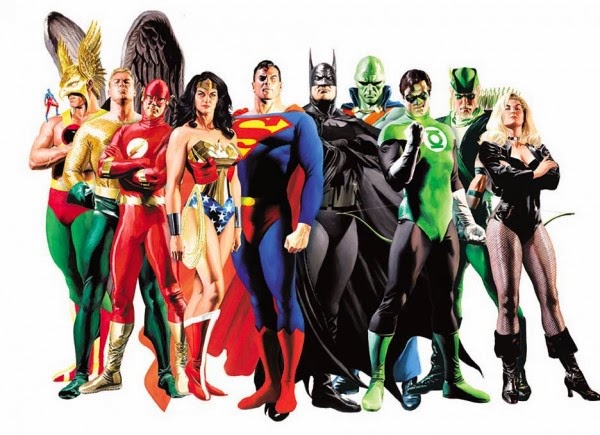
What if all of the talented, creative dedicated people that I know who are focusing their time and energy on various social good causes through their non-profits, got together and picked one cause - the one with the most important widest ranging impact on the world - and joined forces, talents, and networks to create a sort of 501(c)(3) Justice League ?!


What could we build?

I'll give you that its not an idea without its problems:

  • Limited seats for women - slim pickings after Wonder Women
  • The Maginot Line between DC Comics and Marvel Comics would have to be crossed in order to bring in au currant superheroes like Thor, IronMan, and the X Men.
  • Not enough room in the Invisible Jet for everyone to get around.
  • Someone would get stuck as AquaMan.  Not my problem, as long as I get to be Flash... (AH-AH!!)

Its crazy.  But it might just be crazy enough to work.

The 501(c)(3) Justice League.  Now accepting applications....

October 25, 2013

Masculinity. In seventeen syllables.

The Good Men Project has published a haiku that I submitted on the subject of masculinity.

October 24, 2013

Wisdom on Life and Happiness Dispensed by Maria Popova

Maria Popova writes a weekly column called Brain Pickings for the last seven years.  What follows is the best of her ideas.  Read, think and be happy:
  1. Allow yourself the uncomfortable luxury of changing your mind. Cultivate that capacity for“negative capability.” We live in a culture where one of the greatest social disgraces is not having an opinion, so we often form our “opinions” based on superficial impressions or the borrowed ideas of others, without investing the time and thought that cultivating true conviction necessitates. We then go around asserting these donned opinions and clinging to them as anchors to our own reality. It’s enormously disorienting to simply say, “I don’t know.” But it’s infinitely more rewarding to understand than to be right — even if that means changing your mind about a topic, an ideology, or, above all, yourself.
  2. Do nothing for prestige or status or money or approval alone. As Paul Graham observed, “prestige is like a powerful magnet that warps even your beliefs about what you enjoy. It causes you to work not on what you like, but what you’d like to like.” Those extrinsic motivators are fine and can feel life-affirming in the moment, but they ultimately don’t make it thrilling to get up in the morning and gratifying to go to sleep at night — and, in fact, they can often distract and detract from the things that do offer those deeper rewards.
  3. Be generous. Be generous with your time and your resources and with giving credit and, especially, with your words. It’s so much easier to be critic than a celebrator. Always remember there is a human being on the other end of every exchange and behind every cultural artifact being critiqued. To understand and be understood, those are among life’s greatest gifts, and every interaction is an opportunity to exchange them.
  4. Build pockets of stillness into your life. Meditate. Go for walks. Ride your bike going nowhere in particular. There is a creative purpose to daydreaming, even to boredom. The best ideas come to us when we stop actively trying to coax the muse into manifesting and let the fragments of experience float around our unconscious mind in order to click into new combinations. Without this essential stage of unconscious processing, the entire flow of the creative process is broken.
    Most importantly, sleep. Besides being the greatest creative aphrodisiac, sleep also affects our every waking moment, dictates our social rhythm, and even mediates our negative moods. Be as religious and disciplined about your sleep as you are about your work. We tend to wear our ability to get by on little sleep as some sort of badge of honor that validates our work ethic. But what it really is is a profound failure of self-respect and of priorities. What could possibly be more important than your health and your sanity, from which all else springs?
  5. When people tell you who they are, Maya Angelou famously advised, believe them. Just as importantly, however, when people try to tell you who you are, don’t believe them. You are the only custodian of your own integrity, and the assumptions made by those that misunderstand who you are and what you stand for reveal a great deal about them and absolutely nothing about you.
  6. Presence is far more intricate and rewarding an art than productivity. Ours is a culture that measures our worth as human beings by our efficiency, our earnings, our ability to perform this or that. The cult of productivity has its place, but worshipping at its altar daily robs us of the very capacity for joy and wonder that makes life worth living — for, as Annie Dillard memorably put it, “how we spend our days is, of course, how we spend our lives.”
  7. “Expect anything worthwhile to take a long time.” This is borrowed from the wise and wonderful Debbie Millman, for it’s hard to better capture something so fundamental yet so impatiently overlooked in our culture of immediacy. The myth of the overnight success is just that — a myth — as well as a reminder that our present definition of success needs serious retuning. As I’ve reflected elsewhere, the flower doesn’t go from bud to blossom in one spritely burst and yet, as a culture, we’re disinterested in the tedium of the blossoming. But that’s where all the real magic unfolds in the making of one’s character and destiny.

September 20, 2013

The #EducationPapers Project


In the midst of a mind-blowing sprawling online discussion group on the topic of Education, which I have the pleasure of moderating.

Here was the first post:

"I have come gradually to understand that the liberal arts cliché about teaching you how to think is actually shorthand for a much deeper, more serious idea: learning how to think really means learning how to exercise some control over how and what you think. It means being conscious and aware enough to choose what you pay attention to and to choose how you construct meaning from experience.  Because if you cannot exercise this kind of choice in adult life, you will be totally hosed."  

        -- David Foster Wallace, This is Water

Hello All-

There are so many possible places to start, but let's start here.

To set up the first question, a quick introduction.  Earlier this week, I went to lunch with some potential clients and the conversation turned to education.  One of our party, who had been raised in Singapore and England, was asking about how charter schools worked (and whether they did).  From there, we got into topics such as teaching to the test, incentives set up for public schools based on legislation like No Child Left Behind, and so forth and so on.  Towards the end, another of them, an older gentleman, and quite a sharp guy said something to the effect of this: 

The problem with education in this country is that its politically wrong/incorrect to say what needs to be said (which he then went on to say, and he said this:) There are some small percentage of students (say less than 10%) that are extraordinary/curious/motivated/supported and will truly excel.  There is another relatively small percentage (say 15%) that are in the middle that, if given the right support, can also excel.  But there is a large percentage that are, he said, hopeless. And in our system, in our public schools, instead of dedicating resources to the first two groups, we are dedicating 90% of the money/time and resources to those for which it probably won't matter, while at the same time short-changing the first two groups.

His statement rankled me.  Putting aside with whether it was true, it seemed to take such a . . .  utilitarian and striated view of education.  On the other hand, I suppose though, if it is systematically true, isn't it problematic if there are classrooms in schools where the brighter kids are not challenged adequately or given enough attention, or where the lowest common denominator sets the bar.  (Oooh - starting off somewhat controversially..!!).

This leads me to discussion Question Number 1:  What is your reaction to his statement and what do you make of it? 

Second piece of background is this: Last night, at my parent's house, my dad gave me a copy of Richard Feynman's Lectures on Physics.  Feynman was a brilliant physicist and teacher, who taught at CalTech in the 1960's.  He is also a very thoughtful person on the nature of education and learning.  These lectures are serious stuff.  In his preface, Feynman states: "The lectures here are not in any way meant to be a survey course, but are very serious.  I thought to address them to the most intelligent in the class and to make sure, if possible, that even the most intelligent student was unable to completely encompass everything that was in the lectures - by putting in suggestions of applications of ideas and concept in various directions outside the main line of attack."

Towards the end of his preface, Feynman ruminates on whether his course was a success: "My own point of view - which, however, does not seem to be shared by most of the people who worked with the students - is pessimistic.  I don't think I did very well by the students.  When I looked at the way the majority of the students handled the problems on the examinations, I think that the system is a failure."  Which led to this thought:

"I think, however, that there isn't any solution to this problem of education other than to realize that the best teaching can be done only when there is direct individual relationship between a student and a good teacher - a situation in which the student discusses the ideas, thinks about the things, and talks about the things . . . . But in our modern times we have so many students to teach that we have to try to find some substitute for the ideal. . . . "

I found this to be an interesting statement about education.  Also interesting that it was made 50 years ago!

So, Question Number 2: How do we most effectively build (or make sure that we have) a gigantic scalable system that effectively teaches, motivates, inspires curiosity and thirst for learning, and prepares our children with necessary skills for not only a good career but a good life?  (Yup - that one is open-ended as hell.  Go for it!)

P.S. - For more Feynman - sorry that he kind of took over the first post here....see this very interesting transcript of him explaining the complexity and multiple layers to any question.  Feynaman on Why Questions: http://lesswrong.com/lw/99c/transcript_richard_feynman_on_why_questions/.  Which my Dad remarked reminded him of the probing dynamic mind of a child asking why.  But why?  But why? 


Even more on Feynman here: http://www.feynman.com.  Good good stuff.

The #PrivacyPapers Project


We recently concluded an absolutely wonderful online discussion group of online privacy issues & data collection that I had the pleasure of moderating.

Here was the first post:

Welcome to The Privacy Papers (Friend us on Facebook!!  #FollowUsOnTwitter! Pin us (?) on Pinterest!  Make us your boyfriend/girlfriend on Tinder!), where I email questions on the topic of privacy to a group of fascinating and fantastic volunteer luminaries (those being you!), and we trade emails for the rest of the week (or maybe more; not sure yet) beating this horse until its good and dead.  

If, by some miracle, this works out and is both fun and interesting, there will be future series on education, parenting, mindfulness practice, rainbow-looming, and spelunking.  And I'll quit my day job as a lawyer.  (But don't worry!  Please.  Don't worry.  You just signed up for this one.) 

The Daily Show Breaking News:  Google: "Gmail users can't legitimately expect privacy."  Just like Google can't legitimately expect us to use Google+.

I want to kick off our #PrivacyPapers discussion with a TEDx talk given by Chris Soghoian last year, which I think does a nice job of framing some of the key issues I see, including the economics of privacy (dealing in the value and monetization of user data), the power of companies like Facebook and Google (and many many others), government surveillance, and more.  (Now, with 20% MORE government surveillance!)

Watch it (or at least browse the transcript here): 

For those of you who don't want to watch it, here is a snippet from his talk: 

"The dominant business model in Silicon Valley is to provide free services to consumers in exchange for their personal and private information.  They give fantastic social networking services, free email, web brewers and other software and in exchange they collect our data and they monetize it."  

In other words, to borrow from Field of Dreams, sort of:  "If you build it, they will come.  And then you monetize them."  Or as one of the comments below the above video so astutely noted, "if its a free service, more than likely you are the product."  Or, to continue on the movie riff, let's just say, the world might be ready for the a privacy documentary entitled "Monetize Me."

(See, now its like you pretty much watched it.  Except for the other 15 minutes that you didn't see, which really are pretty good.  But for chrissakes.  How much time does this guy think I have...?!).

Anyway, Soghoian closes his talk by stating that when it comes to choosing between the business model and privacy, privacy never wins.  The business model will win every time.  And therefore, "if we want privacy, we are going to have to start paying for it."

This leads me to my first question: 

Do you like Gladiator movies?  (No no - I'm kidding.  That's just a line from the movie Airplane.  That's not *really* the question.  Everyone loves Gladiator movies.  Duh.  And what does that have to do with privacy, anyway?!)

No, the first question is this:  What the heck does this mean?  "If we want privacy, we are going to have to start paying for it." 

Second question (which is in three parts - "I will answer the last part, first...") goes to the alleged power of these companies collecting and mining the data.  

To set the stage a bit, this is from a Mitch Kapor interview:  "I think that in all generations...leaders in the industry had a very complicated mix of motives that are party idealistic, partly pragmatic, and partly Darth Vader...[they key difference is how powerful their companies have become]...What you do isn't just affecting 5 or 10 million nerds and geeks, its everybody and everything."

In a similar vein, this Harvard guy I follow on Twitter, Umair Haque tweeted this series of thoughts the other day:

  • ·      "We have the worst of all worlds when it comes to the politics of tech.  Institutions are opaque; people have no privacy"
  • ·      "That's completely backwards.  In an open society, institutions should be transparent, and people's lives opaque."
  • ·      "In this sense, tech itself is eroding the basic social contract open societies depend upon.  And that's deeply worrying :)"

Alarmist or cause for alarm?

So question two is on a scale of 1 to 11, where one is the lowest and 11 is HUGE in the This is Spinal Tap sense, how concerned should we be about private companies like Google and Facebook?  Why should we or shouldn't we be concerned?  And if we are concerned, what the heck should we/can we do about it? 

AND...........GO!

August 20, 2013

The Privacy Papers 1.0 - A New Project (For No Reason At All)

Well, hello there. 


If you are receiving this email, it means that you have been invited to participate in an email discussion of privacy issues.  This started as a discussion on my Facebook page, and I thought this might be a fun/interesting discussion to have.  I will endeavor as moderator to be as interesting as I can and to make you look even smarter and more engaging than you already are.  No easy task.  Since you are already so smart and engaging.

Of course you are all busy and have lives.  (Or so we say).  And I respect that.  (I do.) And I respect your privacy.  So, if you don't want to play, no problem.  But if you want to participate, please reply and let me know.

Here - for reference - is the original Facebook thread, which has the beginnings of some interesting discussions and some of the flava:


August 8, 2013

Um. Yeah.

Onward and upward.  And sometimes sideways.

But mostly upward.

August 3, 2013

The More Things Change


I read a short but fascinating article in the New York Times earlier this year called "You Won't Stay The Same."  The article discussed a study of the the so-called "end of history illusion" in which people tend to systematically under-estimate how much they will change in the future: "People seemed to be much better at recalling their former selves than at imagining how much they would change in the future."

The reasons for this phenomena are unknown.  But the article offered a few plausible possibilities:

(1) Because we over-estimate our own awesomeness.  We want to believe that we are fully evolved to be the person we are right now, a finished product, so to speak;

(2) Predicting the future - how we will change - is...well...really hard.  In other words, its a failure of imagination.  Its just easier and more comfortable/normal/natural to imagine ourselves as staying the same.

At any rate, the article really resonated with me.  We are constantly changing.  We, in fact, change so much that we - who know ourselves best of all, or at least longest of all - underestimate the extent of our very own transformation.

You know, the whole "No man steps in the same river twice, for its not the same river and he's not the same man" "there is nothing permanent but change" thing.  Change is the only constant.  The more things stay the same, the more things change.  Etcetera.  Etcetera.  Etcetera.

The constancy of change is a theme that I've been reading a lot about lately.

In Buddhism, this is referred to as the principle of "impermanence":

"What makes us suffer is wanting things to be permanent when they are not.  We need to learn to appreciate the value of impermanence . . . Impermanence teaches us to respect and value every moment and all precious things around us and inside us."

                        - The Heart of Buddha's Teaching, Thich Nhat Hanh

I particularly like the way that Sakyong Mipham put it in his book, Turning the Mind Into An Ally:

"The fact is that what appears to us as a solid reality is actually in a state of continuous flux.  The world is a continuous state of flux.  The house that we grew up in is not the same house anymore.  The mother and father that we knew when we were children are physically different now.  Where is our first bicycle?  At one time it seemed to real.  Everything is always coming together and falling apart . . . .  Coming together and falling apart is the movement of time, the movement of life.  This is as obvious as our own face, and yet we imagine our self as solid and unchanging . . . . We feel that everything is just as it appears.  Yet if we look beneath the surface, we find that our universe is not quite as stable as it seems."

Everything is impermanent, both ourselves as well as the world around us.


This drives home the counter-intuitive point that every day, when you wake up in the morning, you are a different person.  How much do I believe this, or should I believe this?  I'm not sure.  I still believe that there are core things about me and you - constants - that make me intrinsically "me" and you intrinsically "you."  And a lot of times I wake up in the morning, and I don't feel all that different.

But surely, we do have great capacity to change.  Not only do we change and impact our world by interacting with it, but our world, by interacting with us, changes us.  In ways that are sometimes difficult to detect and measure.

On the change wrought by adversity ("the storm"), for example, one of my favorite authors, Haruki Murakami writes:

"[O]nce the storm is over you won't remember how you made it through, how you managed to survive.  You won't even be sure, in fact, whether the storm is really over.  But one thing is certain.  When you come out of the storm, you won't be the same person who walked in."

Through adversity, through experiences, through new things we see or read or do or think or say, through the people we meet and the things we share, we certainly are changing.  More than we know.  And that's a wonderfully dynamic thought.

One More Graduation Speech - Erring Towards Kindness

A few months back in what - I am embarrassed to say! - was my last blog post, I wrote about a few of my favorite graduation speeches and harvested some of the thought-provoking wisdom being dispensed to college graduates.

Short declaratory sentences of wisdom.  Like "Wear Sunscreen."  Like "This Is Water."

Today's New York Times featured a graduation speech recently given by George Saunders at Syracuse University this year.  It could be titled, Tending Towards Kindness.  Like the other two, this is going in my great speech pantheon.  Welcome to the party George!

His speech contains a wonderfully put kernel of universal truth.  And great wisdom.  Which is why I wanted to share the full speech here.  

Some snippets are below:

"What I regret most in my life are failures of kindness.

Those moments when another human being was there, in front of me, suffering, and I responded...sensibly.  Reservedly.  Mildly.

Or, to look at it from the other end of the telescope:  Who, in your life, do you remember most fondly, with the most undeniable feelings of warmth?

Those who were kindest to you, I bet.

Its a little facile, maybe, and certainly hard to implement, but I'd say, as a goal in life, you could do worse than: Try to be be kinder.

*   *   *
Why aren’t we kinder?
Here’s what I think:
Each of us is born with a series of built-in confusions that are probably somehow Darwinian.  These are: (1) we’re central to the universe (that is, our personal story is the main and most interesting story, the only story, really); (2) we’re separate from the universe (there’s US and then, out there, all that other junk – dogs and swing-sets, and the State of Nebraska and low-hanging clouds and, you know, other people), and (3) we’re permanent (death is real, o.k., sure – for you, but not for me).
Now, we don’t really believe these things – intellectually we know better – but we believe them viscerally, and live by them, and they cause us to prioritize our own needs over the needs of others, even though what we really want, in our hearts, is to be less selfish, more aware of what’s actually happening in the present moment, more open, and more loving.
*   *   *
Since, according to me, your life is going to be a gradual process of becoming kinder and more loving: Hurry up.  Speed it along.  Start right now.  There’s a confusion in each of us, a sickness, really:selfishness.  But there’s also a cure.  So be a good and proactive and even somewhat desperate patient on your own behalf – seek out the most efficacious anti-selfishness medicines, energetically, for the rest of your life."

April 17, 2013

Wearing Sunscreen In This Water - From the Mundane to the Profound

While we're on the topic,  I also really like a good hard-hitting "how to live life" kind of speech.  Commencement addresses, when done right, can sometimes be a good source for this sort of inspiration and perspective.  (Even though the only thing I remember about my own college graduation was how blazing hot it was.  But I digress.)

At any rate, I've happened across two such speeches that I like very much over the past few days.

The first, well,  wasn't actually a commencement address.  But, as urban legend would have it, it was a commencement speech delivered by one Kurt Vonnegut.  Not true, as it turns out.  The "Wear Sunscreen Speech" was a 1997 column from the Chicago Tribune written by one Mary Schmich.  I remember reading it years ago.  Worth re-reading.  Not fall-off-your-chair awesome, but nicely done.

What I particularly love about it is the way it juxtaposes the mundane ("floss") with the profound ("Sometimes you're ahead, sometimes you're behind.  The race is long and, in the end, it's only with yourself.").  Because that is what life is, a cross between the mundane and the profound.

Oh, and here's a couple neat things that Kurt Vonnegut actually did say:

  • "Hello, babies. Welcome to Earth. It's hot in the summer and cold in the winter. It's round and wet and crowded. At the outside, babies, you've got about a hundred years here. There's only one rule that I know of, babies—God damn it, you've got to be kind." 
  • "I urge you to please notice when you are happy, and exclaim or murmur or think at some point, 'If this isn't nice, I don't know what is.'"
Yup.  He's good, that Kurt Vonnegut.  Kilgore Trout would be proud.

The second, entitled "This is Water," is a 2005 commencement address delivered by the incomparable David Foster Wallace.  I had never come across this before.  Love it.  This piece should simply be required reading.

Interestingly, it also touches on the connection between the mundane and profound.  Perhaps we're on to something here?!

Some snippets to entice you:

"There are these two young fish swimming along and they happen to meet an older fish swimming the other way, who nods at them and says "Morning, boys. How's the water?" And the two young fish swim on for a bit, and then eventually one of them looks over at the other and goes "What the hell is water?" . . . .  

If you're worried that I plan to present myself here as the wise, older fish explaining what water is to you younger fish, please don't be. I am not the wise old fish. The point of the fish story is merely that the most obvious, important realities are often the ones that are hardest to see and talk about. Stated as an English sentence, of course, this is just a banal platitude, but the fact is that in the day to day trenches of adult existence, banal platitudes can have a life or death importance, or so I wish to suggest to you on this dry and lovely morning. . . .

The point here is that I think this is one part of what teaching me how to think is really supposed to mean. To be just a little less arrogant. To have just a little critical awareness about myself and my certainties. Because a huge percentage of the stuff that I tend to be automatically certain of is, it turns out, totally wrong and deluded. I have learned this the hard way, as I predict you graduates will, too. . . .

[L]earning how to think really means learning how to exercise some control over how and what you think. It means being conscious and aware enough to choose what you pay attention to and to choose how you construct meaning from experience. Because if you cannot exercise this kind of choice in adult life, you will be totally hosed.

The really important kind of freedom involves attention and awareness and discipline, and being able truly to care about other people and to sacrifice for them over and over in myriad petty, unsexy ways every day.

It is about the real value of a real education, which has almost nothing to do with knowledge, and everything to do with simple awareness; awareness of what is so real and essential, so hidden in plain sight all around us, all the time, that we have to keep reminding ourselves over and over:

'This is water.'

'This is water.'"